
Back in 2019, I had started working on a gay romance with a “Great Mage” as a protagonist. A very cute guy. That’s Eric. Not the Wizard. I had just finished the preparations (creating characters and their background, outlining the story, writing notes for certain scenes, etc.) and was working on the opening chapter, when Turtle Writers’ writing prompt 105 came out.
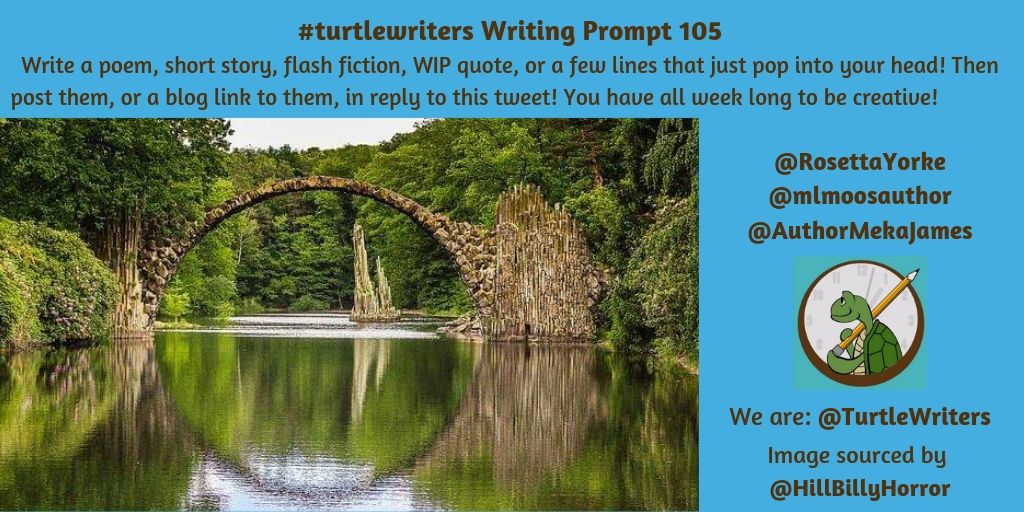
And on seeing that, I saw two guys in a boat going down the river to pass under that bridge… Oops! 🤐️
(Ok! I might or might not post that chapter in this Wizard-related posts. I’ll decide at a later time.)
So, in that story, a wizard was necessary to make the story happen, proceed, and secure a happy ending. He would be a secondary character, just for the needs of that story. And that’s how the Wizard was born.
My Usual Cast of Characters
Most of my stories have the two main characters (sometimes it’s possible to say who is the MC and who is the LI, but other times it’s not) and either just them, or with:
-
Some “quaternary” (or even lower-tier) ones.
-
A secondary character who is needed for the story to proceed smoothly, and maybe some minor characters.
In “The House in the Lake” for example, there are only two characters – no third at all. “The Demon of the Three Rivers”, though, which concludes the story, introduces more characters, since it starts ten thousand years earlier.
“1000” has Death as its secondary character. I usually call those characters “helping characters”, whether they are supportive (most commonly) or hostile (rare) towards the couple. In “1000”, Death is supportive. Peter’s parents, who also appear, are too minor to be called secondary. Maybe not even “quaternary”. 😏️
The Wizard’s company
The Wizard was an odd secondary character from the get-go. After all, unlike others, he came as a whole group. From the start, he had three familiars. One from the element of water, one from the element of earth, and a fiery one. Galen and Dagwood, whom you might already know if you have read “The Wizard and the Green Dragon”, are the water and earth familiars respectively.
Needless to say, I needed to build the characters and backstory of those familiars, as well. As I was working on the third familiar, I fell in love with him. None of the three familiars plays a major role in that story, but the fiery one stands out a bit more than the others.
But that was not enough. He needed his own story, or, if you prefer, a story where he would be one of the main characters.
Then, let’s start preparing his story, too, right?
Who did you call a secondary character?
I should have realised by then, I had fallen in the Wizard’s trap, but I was too slow at grasping the situation. 😌️
So, I did all the usual preparations for the new story, and all looked right. Hence, I started writing it. In case you didn’t notice, I never said I had started writing the Wizard’s first story. I had done all the preparatory work, though.
I wrote the three chapters relatively easily and relatively fast. Then, due to the long-lasting first lockdown progress slowed down. A lot!
In any case, the Wizard is supposed to be a secondary character in this story, as well, with his third familiar and a human taking the lead roles. But the first three chapters are dominated by the Wizard, while the human appears for the first time in the second half of the third chapter.
Okay…
I was following my outline and scene sequence just fine, I must say. It’s true that the Wizard’s role was slightly bigger than I thought it would be, but not in an unpleasant or unfitting way. And it wasn’t too much of a surprise that the human protagonist entered the story late. After all, the Wizard goes to that world two centuries before the human was born.
I was still naive!
Long story short, now half of the story is written and the Wizard, although a secondary character, still runs the show.
I gave up on fighting against him and trying to reduce his role, because he makes things flow smoothly. Let’s say I am writing a romance where the love story is not the only thing. Most romances are like that. Yes?
You might say that, “yes, but still the MC has the biggest role”.
My hearing is bad. Okay? I can’t hear you! 😇️
The Wizard as the Main Character and not only
As the Wizard realised I’m unwilling to rein him, he decided he wanted a story with him in the protagonist’s role, or, if you prefer, where he has the biggest role and I’m not calling him a secondary character.
After some fighting, we compromised in writing a short story to be added at the end of the second story of the Wizard.. This short is “The Wizard and the Green Dragon”.
I was happy with my (half) victory, but for the Wizard this was just the start. From then on, every now and then, he decides he wants another story. And insists on it! I tried to ignore him, at first. Without success. He “haunts” even my dreams. So, I take some notes, at least, just to calm him down.
“I want to meet Eric,” he decided one day… He did, as you can guess.
There was another story I had started preparing – not writing – some years before the Wizard’s and Eric’s stories. I had shelved it (or maybe “drawer-ed” and locked), because there’s a certain spot in that plot where I couldn’t come up with a solution to make everything fit together. There is a wizard in that story, as well.
One day, out of the blue, the Wizard said he wanted to meet that wizard.
“No! Not happening. Not to mention this story is unlikely to ever be written.”
“But you know, if I appear in that time and say this and that to the MC, it solves all your problems. And it gives you an excuse to write mine and that wizard’s meeting as a short after the ending.”
His “this and that” is just one line that the Wizard can say, according to his character and abilities, and it really solves everything. Just so you know, I didn’t admit it to him. 🤫️
Living With the Wizard
These are some basic stuff about the Wizard and how he came in my imagination (and life) and he decided to become the author in my place.
I thought Selfy was the most difficult character I would ever write, but the Wizard is on a whole new level. Many levels above Selfy, too.
For a planner kind of writer like me, he is pretty annoying. Disturbing, even, I’d say. But between you and me, I love him.
I intend to post two more posts about him. One for his character, and one for the cosmology and theology of the “multiverse” where he exists.
Have you ever written a character who decided on their own how their story should be written? Was it fun, or nerve-breaking? And how did you work with them?
That’s all for now!
Be always happy, and always have fun!
💖💖💖💖💖
😘😘😘😘😘
Yorgos KC


-giggles- so you’re a planner, huh? HAH! I’m a pantster…until I hit the middle and then I have to plan, but the last 1/3 is back to pantster again. Don’t fight it. You’ll never win. 🙂
LikeLiked by 1 person
You are so lucky! I assume those little “nasty” characters who *think* they know better how they should be written are much easier for you to work with, since you are willing to give them some freedom from the start?
But yes, you are right. I have never won. I could somewhat reign Selfy, but the Wizard does what he wants to do., no matter how much I fight back. 😮💨
Can I ask how does your method of writing work?
LikeLiked by 1 person
I am a pantster hybrid. I get an idea and then see where it takes me. I literally don’t know where the story will go or how the characters will evolve.
Then at about the 1/3 mark, I have all these threads created by the characters and events. That’s the point at which I have to ask: ‘where is this story going?’ I try to consciously answer that question but if I try to make a character do something they wouldn’t naturally want/be able to do, I write myself into a ‘block’.
It’s only when I go back and let the characters do what is right /for them/ that the story gets going again. That’s the middle 1/3.
The last 1/3 is usually pure pantsting again because I can ‘see’ how all the threads sort themselves out and all I have to do is write it down.
That’s it in a nutshell BUT…that’s my first draft, and it is always for me. Only for me. It’s my journey of discovery.
I don’t start writing for the Reader until the second draft which could include some serious re-structuring. The restructuring is why I use StoryBox. It’s a project manager for writers [similar to Scrivener].
Honestly, if I had to use Word, I’d never finish anything.
lol too much information?
LikeLiked by 1 person
Not at all, Meeka! On the contrary, thank you very much for diving into your process like that! 😍
I love your “pantster hybrid” term. I find it accurate, too! Your process is quite fascinating. I love how you let your characters tell you their story – even if you reign them during the middle third – and you discover them almost as if you were the reader. Does that middle third usually feel like a fight, or like a cooperation?
For me discovery happens before starting writing the story, but it’s more like investigating their whole lives. Events that happened since their birth (or before) and have affected their character. Mostly things that are not meant to be in the story. But that’s what helps me feel them as real people, understand how they think, what small reactions they should have at any time, what words they’ll chose to use, and things like that. 😇
The thing you said that forcing the characters to do/say something against their nature and will leads to a block, is also very true. It does the same for me, even though I’m a planner, and even if I work with the most obedient of characters. Not to mention people like the Wizard. 😒
I hadn’t heard of StoryBox before, and I’m intrigued! Is it something you download to your computer, or is it online? And also, can you elaborate more on how this helps you? I checked the description of Scrivener some years ago, but that’s as far as my knowledge about it goes. So, yeap, I know nothing!
I’ve always found MS Word/LibreOffice Writer quite sufficient for my method of writing and so I have never really researched those tools. I outline the whole story, then write notes for important scenes, each in different file. A linear approach, mostly, so a document editor is enough. But, if I got it right, your second draft process is not really linear?
What you call “first draft” is like what I call “zeroth draft”. A draft that doesn’t look at all like the final story, and is not edited but fully re-written. Did I understand this right?
Last but not least, your explanation on your “hybrid pantster” style has totally shifted how I pictured pantsters. I imagined pantsters were those “lucky geniuses” who nail it on the first go. It’s not meant to downplay your skill at all; if anything, I wished I could pull off that kind of magic myself! Now that you gave me a better idea of the blood, sweat, and tears behind your method, I think you are even more of a genius. Maybe not “lucky” but certainly more genius! 😍🙇♂️💖
Thanks again for sharing this info, Meeka! It’s taught me so much and it’s given me so much to think about. Would you be okay if I shared a link to your reply on Twitter? No pressure. I know you are not friends with it – and it’s Twitter’s lose!
💖😘💖
LikeLiked by 1 person
Starting at the end – no, I don’t mind at all. I still love many of the /people/ I met on Twitter, so go for it. 🙂
Re pantsting…I can’t speak for all pantsters, only myself. I /need/ to pants because otherwise the story becomes a nice, neat treatise on logic…and is as boring as hell! So, to stop the logical side of my brain from taking over, I always write with music. it has to be the right music for the ‘mood’, but still, it’s music that works like a kind of white noise. No lyrics, just melody.
In the middle of the story though, I have to engage the logic a bit, but it must still be character driven. And it’s bloody hard work. I wish I were one of those people who can just dash a story off in an afternoon. 😦
Re first draft. No, because I’m such a perfectionist, the first draft is a whole lot better than a zeroth draft because one single word can change the whole feel of the story. But…no matter how much I may love what I’ve written, when I do that second draft, I have to put everything on the table. If it doesn’t work for the Reader, it’s out.
I usually know something is not working because I keep going back to it, like sucking on a toothache. 😦 Believe me, I don’t want to make big changes but if it doesn’t work, my subconscious just won’t leave me alone until I fix it.
Re Storybox: It’s automatically organised into chapters and scenes so for the first draft it’s more or less linear. But then for the 2nd I can move scenes within a chapter with a single click. Or…I can move a whole chapter up or down until it’s in a spot that works better for the ‘flow’ of the story. I can outline if I want to, or I can use the names of the chapters and scenes as a quick and dirty outline or overview.
A planner like you can create biographies of all the characters etc. I never use any of those functions but they are available so if you need to check something or refer to something it’s right there, but otherwise doesn’t interfere with the actual story.
Oh! You buy Storybox and download it to your pc. Lifetime licence. You own it, you don’t rent it.
If you want to just play around with it there’s a 45 day free evaluation:
https://storyboxsoftware.com/download.htm?i2
Wow…he hasn’t updated it in years, and I’ve been using it for well over ten years!?!
Re the middle third…it is always a fight. With myself. For example, right until volume 3 of Innerscape I refused to allow my characters to finally do the whole romance thing. 3 books I fought it, and finally at the very end I gave in because…it just had to be that way. lol I think I kept the readers guessing too. 😉
Anyway, this reply is waaaay too long. Night night. 🙂
LikeLiked by 1 person
Good night! 💖💖💖💖
Thank you for the permission, and also thank you for all the additional info. You method is really fascinating. The more you explain it, the more find it intriguing. I don’t know if I could ever employ it, but some parts of it would be nice if I could adopt even partly.
Re perfectionism and every word matters, I’m with you. In “Gregory Kirk” I changed half a chapter because I needed a certain paragraph to start with a certain phrase, and it didn’t make sense the way I had written the chapter up to that point. Poor Rosetta Yorke who helped edit it broke three laptops in the process 🤣 (Hope not!)
My zeroth draft is more of a test-drive for the narration. It’s really challenging to nail that. It’s not something I wright lightly, without paying attention, just to clarify this.
Our subconscious has a good feeling of what should and shouldn’t be written, doesn’t it? And glad you added the romance. Romance is needed everywhere! Ok, sorry, but you know me 😅
Thanks for the extra info about StoryBox, too. I’m glad it’s a program you buy and own and I don’t need to “upgrade” or, even worse, have it being upgraded on its own against my approval. Programs that do their job right, don’t need to change! 😏
I’ll check it!
Once again, thank you for your reply. It wasn’t too long. It was just right. I might ask more in the future.
Sleep well, dream beautifully and do have an amazing day when you wake up!
💖🍀😘
LikeLiked by 1 person
Thanks, Yorgos. I actually did have a decent night’s sleep so I’ll blame you. :p
I’m with you on programs that ‘don’t need to be fixed’. All of these stupid upgrades [that you have to pay for] or subscriptions [that you also have to pay for] are just part of the corporate strategy to milk us for every cent without giving much in return. Hate that whole mentality!!!!
Yes re the subconscious. It’s a ‘global thinker’ whereas our conscious thoughts are mostly linear. Both are good in different ways, and for different purposes.
Lol – poor Rosetta! I remember her from my Twitter days. Say hello to her for me please. 🙂
LikeLiked by 1 person