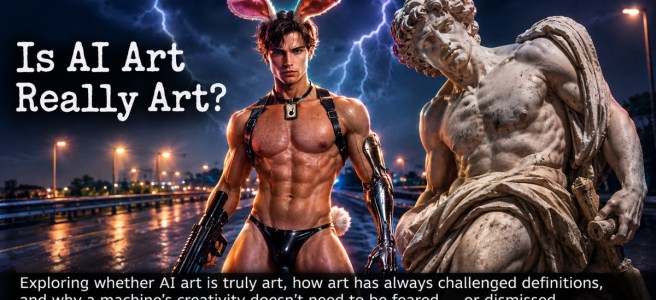
Before disappearing I had promised (or threatened) I’d dedicate Mondays to art related posts. And since I have now also promised to make some posts for AI, I’ll dedicate this post to AI art. But before we start, here is a quick question: Is this image a museum piece or an AI creation?
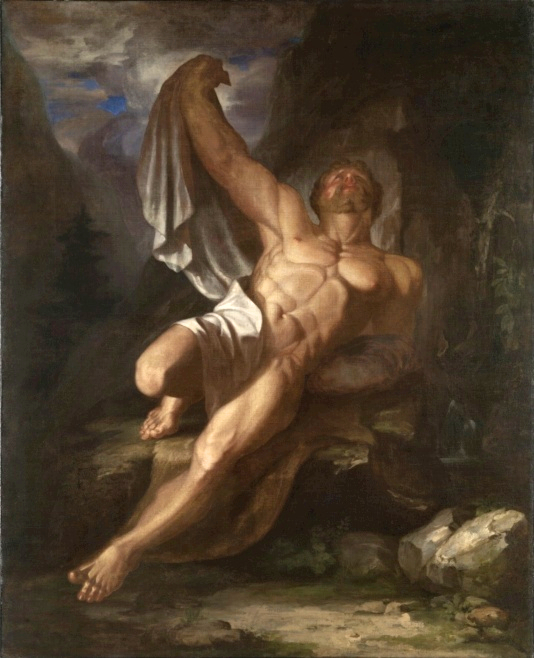
There are some points of interest in it, right? The claw-like hand, the arm that looks more like a twisted tube rather than a human’s arm and the sixth toe can be good giveaways.
So, yes, undoubtedly, this is a museum piece! Not quite what you had deduced, unless you already knew this oil painting, huh? But I’m speaking the truth. This 19th-century piece is hosted in Yale University’s Art Gallery and it’s painted by a very famous artist.
An artist so famous that even grade-schoolers, or people who have absolutely no interest in art know him. Although, truth be told, we mostly know him because of his hobby (inventor) rather than for his living-providing job (painter).
This guy, unlike other famous artists, didn’t have a habit of dwelling in the sewers, eating pizzas, learning martial arts from a rat, or saving the world from villains. No. Instead he enjoyed playing with dots and dashes and using them to create formations that could convey a clear meaning. Something like this:
. . . – – – . . .
You see? You know him! Yes, he is Samuel Morse, co-inventor of the single-wire telegraph and the Morse code.
To be honest, I don’t like this painting, despite its theme, but that’s personal taste. I also don’t understand why it’s considered a masterpiece, but, once again, that’s not my speciality. There are plenty of artists – of any kind of art – well-known and well-appreciated whose creations I don’t like, whether I understand their greatness or not. And that’s pretty okay.
My usual example is Johann Sebastian Bach. I love this lunatic, I understand his genius, and I hate his music. You see, music has rules. There are some harmonies that have a pleasant sound and some that don’t. There are some combinations of harmonies that are very… harmonious and some that are not. So, Bach said, “Okay! Let’s take all the unpleasant harmonies and all the bad combinations and make music.” And he did. Very good music, too.
I can tell a piece is Bach’s – even if I don’t know it – just by how it captivates me from the first note, and it strongly irritates me after a minute at most, but I still can’t find a fault to it.
Should I call Bach a bad composer just because I don’t like his music? By all means, no!
Writing (which is an art and not a craft, in Greek), and any other form of art is a very subjective thing. If a piece can make happy or inspire even a single individual, it’s a good piece, whether I like it or not. And I’m not sure how many people Morse’s art made happy, or inspired – not few probably, since he lived off of his art – but Bach’s music has inspired and keeps inspiring more than just plenty. Metal, for example, is very much influenced by Bach’s compositions.
Even if a piece or an artist is not recognised, or accepted, it doesn’t mean their creations are not good. Vincent van Gogh is a prime example of this. Although now his work is very highly valued, in his time nobody saw anything of value in it.
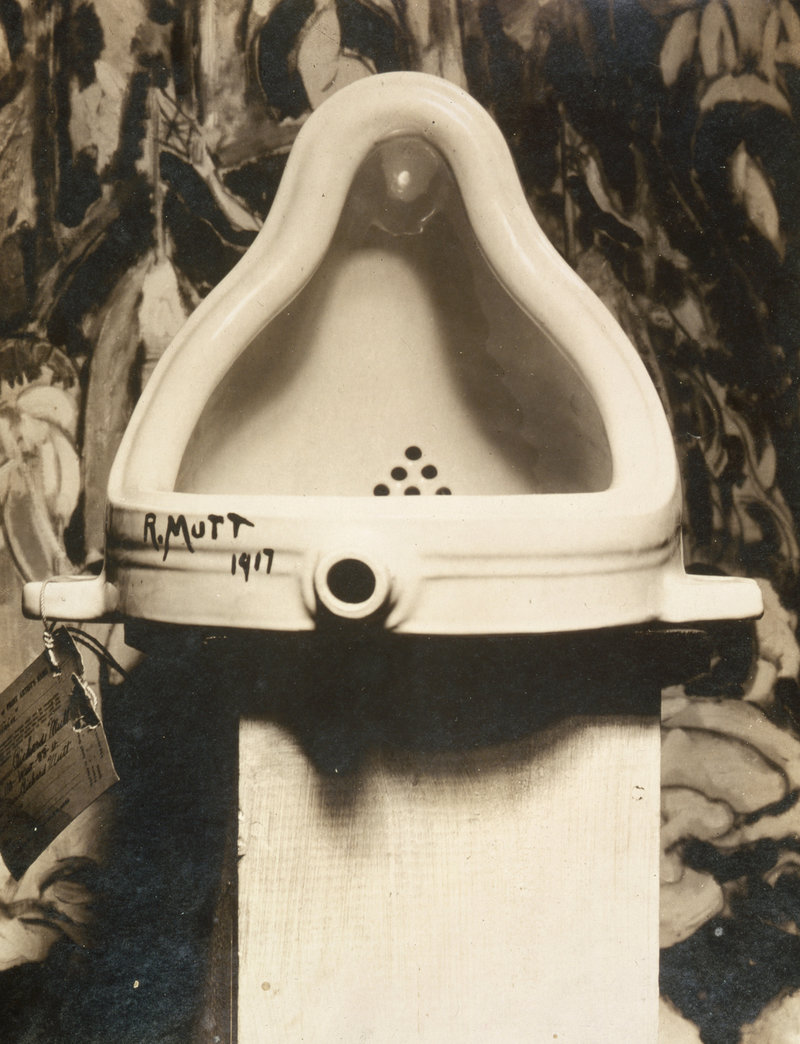
Another quick question. Would you call an urinal a piece of art? One that would “make history”? You probably know already that this is a trick question, so indeed, the answer is, “Yes!”. Marcel Duchamp created such a piece, and exhibited it, which provoked the anger of many and the piece was destroyed.
Nonetheless, the “Isaac Newton” of artistic photography, Alfred Stieglitz, had the opportunity to immortalise the original through his own art, while countless copies of the “Fountain” have been created since then.
So, the definition of “art” is quite vague. Digital art and even photography have not been officially recognised as forms of art, and neither has AI art.
One of the excuses used to exclude AI creations from art is that a machine does all the work. Well, strictly speaking, in photography a machine does the whole work, but that has never been the reason photography isn’t recognised as art.
And if we forget studio photography, where the photographer sets everything up, street or landscape photography are “compositions” the photographer finds ready and turns them to an image. He only decides what is worth photographing, the exact framing, the moment and the camera settings.
Similarly, an AI artist programs and fine-tunes the model and decides the prompt and receives the result.
Just because their tool (AI) is faster than mine (brushes) it doesn’t mean what they create is not art.
There is a very good reason there are so many people on Twitter (or used to be when I was active there) who time and time again create atmospheric and expressive images, even on demand, while I can’t make a single one that comes close to what I hope to see. It’s because it’s not the “machine” that does all the work, and I have no idea how to use that tool.
Well, my subject is difficult. Without a trained model it’s easy for the AI to make anatomical mistakes. Not to mention it can’t create anything that looks like a dick.
But if we forget the male nude, it is true that it’s easy to make an image, just like it’s easy to take a digital photo. And just like not all photos are art, similarly not all AI creations are art. That’s true. But assuming that just because “not all” are art means that “none” is, is like saying that because not all plants are edible, none of them is.
And, also, it’s true that the tool is not yet well-developed and it can’t depict some things realistically enough, but that will change. The same “tool” that created “Toy Story 1” with those very unrealistic movements and expressions, now – many improvements later – can do a much, much better job. AI will get there, and quite soon, too, I believe.
And that means that more people, less capable of programming models, will be able to produce the results they want. But is this really a bad thing? And will this mean that all these people are artists?
Artistic creativity, other than producing art pieces, can help with many issues, including and not limited to psychotherapy. It’s okay if you can persuade the patient that it doesn’t matter how well they’ll draw what they’ll draw. But do you really think that all patients will be convinced? Some – not few – will feel pressured or disappointed by a result that doesn’t look anything like what they intended. And that can actually have a negative impact.
That’s why a professional won’t advise every patient to use such methods. But if AI gets better at creating what the prompt tells it, more people will be able to artistically express themselves, and, hence, enjoy the benefits of such a therapy. And that’s just one example. So, no, it’s not a bad thing at all.
And as for whether all of them will be artists, I’ll repeat the photography example. Just like not everyone who takes a photo is an art photographer, not everyone who uses AI will be an AI artist.
As for whether AI “steals” things from others, that’s a very different issue, because this has nothing to do with the user, but only with the company running the AI. I’ll answer this with a slightly exaggerated example. If a Prime Minister or President murders someone, should we imprison the whole country because they enjoy the benefits of living in the same country that person rules?
Have fun, be creative and give the finger to whomever tells you not to!
Love and Kisses,
💖💖💖😘😘😘
Yorgos KC


A very thought-provoking post, my friend! One that provides us some validation of the proverbial adage: “through the eyes of the beholder!” Whatever we regard as art will afford others a stage for their opinion. No matter our judgments, there will be those who agree and those who disagree. We just have to live with both! Life goes on! 😉 Naked hugs! Great work here!
LikeLiked by 1 person
Very true. If anyone’s art is approved by everyone it’s either because that person has enough power and influence to silence opposition, or because that person did nothing to excite/inspire and hence provoke anyone, or so I think.
Thank you very much for your encouragement (and hugs)!
Love and kisses!
💖💖💖😘😘😘
LikeLike