
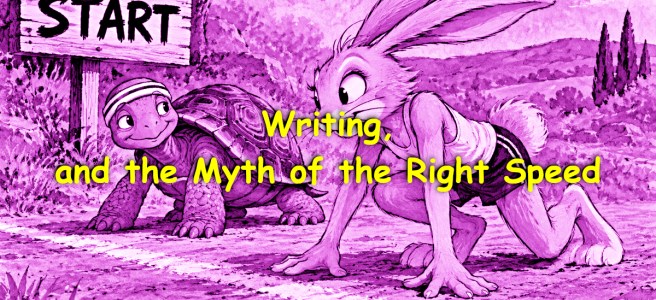
Hello, people!
We’ve reached that month of the year when half of the authors on social media either brag about their word count or disappear. Although, truth be told, NaNoWriMo is not as popular as it used to be, to my understanding.
“Ehm, Yorgos? NaNoWriMo died last year, you know.”
“Really? Oh, fuck! Well, then… We’ve reached that month of the year when half of the authors on social media used to either brag–”
“Yorgos! 🤨”
Okay, more seriously, NaNoWriMo no longer exists, but it was part of writers’ lives for many years. Moreover, similar challenges still exist. And since my point isn’t about this particular challenge, but the mindset behind it, let’s keep NaNoWriMo as a historical reference.
The Mascot Isn’t the Problem
I’m the kind of guy who supports St Valentine’s against those who accuse it of being a “commercialisation of love”, under the argument that any opportunity that allows one to focus on, and dedicate time to, their loved one is a good thing. So, why should I think differently about a writing opportunity?
But just like Valentine’s can be a dreadful day (or period) for unintentionally-singles, challenges like NaNoWriMo (from now on I’ll be using “NaNoWriMo” for simplicity) can also be a curse for those who don’t meet their standards. The most important difference is that those who don’t meet Valentine’s standards – if you allow me the expression – rarely, if ever, consider themselves failures because of that, while those who don’t meet NaNoWriMo’s standards tend to assume they aren’t good enough authors.
So, let’s see why this is total bullshit.
NaNoWriMo itself is not the cause of the problem. Just like that famous, arrogant cousin of mine with the bow-tie who has trademarked his profile is not the cause of lust, but just a mascot representing (a certain kind of) it, NaNoWriMo is a mascot of a writing – and not only – mindset that, contrary to lust, is quite faulty. Let’s focus on writing and what this mindset says for it.
To be a good writer, you need to be able to create on demand (during this month, for example). You need to write past a certain speed and achieve a minimum daily quota. And, of course, you need to meet the deadline (the end of the month, for example).
Why???
Progress Doesn’t Come in Neat Numbers
Whether we write 100 words or 10,000, isn’t it progress? Moreover, we are humans and our mind and emotional condition are not always the same. We have good days and bad days. So, isn’t it natural that some days we write more, some days less, and some days we can’t write at all?
“A proper author should be able to overcome those and produce regardless.”
Bullshit!
(That’s the second time, by the way. Let’s count how many times I’ll use this word in this post.)
Unlike a singer who performs in front of a live audience, we, authors, don’t have such a restraint or reason to pretend. And if we can’t attune ourselves to the feeling of what we are describing, how can we describe it convincingly?
Also, I personally believe in quality over quantity. It’s awesome if we can achieve both, but if not, is it better to force more words onto the paper, even if they feel wrong?
Okay, I admit, that’s not a very straightforward question, or more accurately, the answer to this question is the one which is not straightforward. Because, it depends.
If you have plenty of time (and that “plenty” is subjective), forcing unpolished words out, just to write the story, even if badly, can be a plan. You can later polish or rewrite this. But if you don’t have enough time, this might not be the best strategy. Moreover, if we really force ourselves to write when we can’t, the story might take a path we don’t want it to take. In my opinion, that can very well be a waste of resting time. And rest is also useful.
Of course, if you don’t really know how you want the story to develop, that counts as experimentation, not a waste of time. So, please try to understand what I’m trying to say, instead of nitpicking about the details, for – let’s face it – if I want to cover all possible scenarios, this post will become too huge to read.
So, to recapitulate, our progress is not measured – nor should it be measured – in daily quota, uniformity, etc. Progress is good progress regardless, while lack of progress doesn’t equal failure.
How to Measure Success 😏
Not really writers these guys, but between Pablo Picasso (creator of “Guernica”) and Sandro Botticelli (creator of “The Birth of Venus”), who would you call a good artist and – more importantly – who would you call a failure? Neither? Then keep that in mind for yourself!
It’s true that Picasso was an active artist for more years than Botticelli lived, but even if we take that into account, Picasso created a few tens of thousands of pieces, while Botticelli created a few tens. Or if you prefer, on average Picasso was creating more than twenty pieces per month, while Botticelli was creating two or three pieces per year. You get what I mean. Right?
So, the amount of our words per day, the amount of our total finished works and even the amount of the people who recognise our work as good doesn’t say anything about us as authors. I often use the unparalleled failure of an artist – judging from the number of people who appreciated his work in his time – Vincent van Gogh, in such cases, but let me instead use a Greek poet who, in his time, was considered to be one of the greatest poets ever.
Achilleas Parashos (Αχιλλέας Παράσχος) was not only considered a national poet, and one of the best, but he also was so popular that he lived off of his poems. Even more so, politicians of his era appointed him to several positions (without expecting him to do any work) just so that the state could give him a salary.
King George I of Greece attended his funeral, and a total of 20 funeral speeches were read. On that day and daily for months – according to Xenopoulos – his fans were adorning his grave with flowers and mourning the loss of the greatest national poet.
He is a “nobody” now.
Here is one of his very successful romantic poems – yes, it’s just four lines.
That is, which equals viz,
in other words namely,
Aphrodite is you,
you are Aphrodite.
(Τουτέστιν, ίσον δηλαδή,
εν άλλοις λόγοις ήτοι,
η Αφροδίτη είσαι εσύ,
εσύ είσαι η Αφροδίτη.)
I think I made this point clear. So, let’s move on.
November Doesn’t Own Your Story
To many of us, inspiration and even motivation to write can come in random moments. There are times when I have a hundred ideas at the same time, and then periods when I can’t think of anything to write. And I’m pretty certain I’m not alone in this?
You know what? Unless your job is exactly this and you have a contract to fulfil, you don’t need to write in November, or any other specific time. Come up with an idea at any time, and write at any time.
If November’s writing challenges (or any others, actually) can help you focus on writing, generating ideas, and starting a project, then that’s really great. If not… well, December is just as good and so is any other month.
Deadlines: Use Them, Don’t Worship Them
As for the deadline, similarly, if it can motivate you and keep you focused on what you are doing, then use it. In fact, set a deadline whenever you write. But if it doesn’t work for you, don’t set any.
I can’t really work well with deadlines. They only stress me and that’s counterproductive. I was the kind of student who never studied before exams, because I couldn’t. I used to feel guilty for that, because all my classmates studied all day long during those days. It was only in the next-to-last year in high school that a teacher “gave me permission” (not specifically me – he was talking to the whole class) to not study right before exams, by saying that some people simply can’t do that, and that if they do it, they are likely to mess up the information in their minds and have worse results than without that “last-minute” studying.
So, in case nobody has told you that, I am telling you: you don’t need to follow any deadline!
Summing Up
Ok! To my surprise, this post ended up being larger than I expected it to become, and, more importantly, only two “bullshit”s (now three) were used – and no other curse-word. Am I ill?
“No, you are not! You said, ‘fuck’, too!”
“Oh, thank goodness!”
Seriously, though, write the way you want to write. Write the amount of words you can. Even one word brings you one word closer to the end of the story. Write every day, or write whenever you can. Write with a deadline or without one. All is good. The only important thing is: write – and make yourself happy with it!
That’s all!
Have fun, write as much as you want, and even when you don’t write bullshit, you can always write the word “bullshit”! (Five times!)
Love and Kisses!
Yorgos KC


