
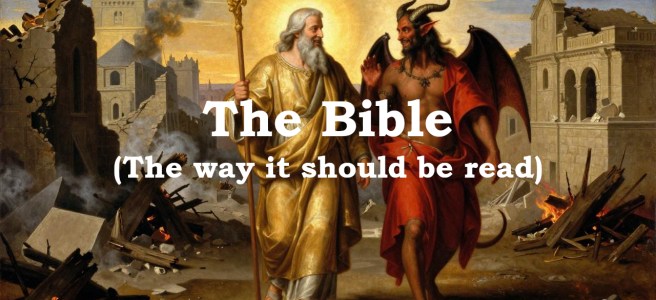
Do you want to read this post?
Warning:
This site and its author do neither support nor respect ideologies that preach or glorify:
-
Discrimination against, or murder of homosexuals (and any other sexual identity and orientation).
-
Discrimination against women.
-
Murder of people who have different believes or opinions.
-
Oppression or damnation of nudity and sexuality.
And that includes – of course – religions that do any or all of those, either through the teachings of their authorities, or through their sacred texts.
If you are a supporter of such an ideology, leave this post and this site.
Disclaimer 1:
I personally believe that humans who believe in a good god, an evil god, a false god, or no god can be good, evil or anything in between. Therefore, I’ll treat humans according to how they treat me. These stand for polytheists, too.
Disclaimer 2:
There is a bunch of books called “The Bible”, but despite the definite article, there is nothing definite about those. The Anglican Bible, for example has 66 or 80 books (depending on whether the Apocrypha are included), the Catholic Bible has 73 books and the Orthodox Bible has 76 books. On top of that, the same books might have a different name (that’s a detail, but it’s worth mentioning). Moreover, the same books might not have the same number of chapters. Finally, (and this is true for the New Testament as well) the same chapters don’t necessarily have the same number of verses. Although these are rare occurrences they exist.
Therefore, some of the things I’ll mention in this post might be different in your Bible. If so, refer to the Ancient Greek text of an Orthodox Bible that has the seal of approval of the Ecumenical Patriarchate.
Both the seal of approval and the Ancient Greek text are important. I translate directly from the ancient text because the Modern Greek translations are usually far from translations. There is a reason the New Testament’s original text is less than half the size of the Old Testament, but its translation is usually two to five times larger than the Old Testament.
And it’s not only that the translators “add sauce”. Sometimes, the “translation” is quite imaginative to the extent of:
Original: Jesus farted.
Translation: The Lord, in his divine glory, made a miracle, and the atmosphere was filled with the pleasant aroma of flowers that shouldn’t be blooming at that time of the year, and everyone was astonished and fell on their knees and praised the Lord.
Yes, this was not a copy-paste from the Bible I use – which means there are no copyright issues – but it gives you a good idea about how… “faithful” the translation can be to the original.
Moreover, if that example made you feel uncomfortable, it’s a good hint you should stop reading this post.
If it didn’t, let’s start!
The Bible’s version of Judas’ story
Even if you are not very good at the subject of Christian religion, you, most likely, know that one of the disciples of Jesus betrayed him, which led to the crucifixion. That’s Judas Iscariot.
So, what does the Bible tell us about that betrayal?
One beautiful day, Jesus booked a table for thirteen in a fancy restaurant and took his disciples there, to have some fun. And then, he gave a prophesy, “One of you will betray me tonight.”
And the disciples started asking if it’s them.
Why?!? If I were planning to betray someone tonight, I would surely know that by this evening! Was it because they trusted Jesus’ words more than their own mind? If so, then why later, when Jesus tells Peter that he will deny him thrice, Peter replies something like, “Jesus Christ! What nonsense are you spouting?”
Back to Judas! Truth is, two out of the four gospels claim Satan possessed Judas, so let’s just say that the almighty, all-knowing god predicted that this will happen and did nothing to stop it.
So, Jesus told them in a roundabout way (which is not the exact same way in all gospels) that Judas was the one who would betray him. Let’s focus on John’s gospel.
Jesus says that the one who will betray him is the one for whom he’ll dip the sop and give it to him, for everyone to hear.
Then he dips the sop and gives it to Judas, for everyone to see.
And Satan enters into Judas. In the presence of his best friend almighty god (the Father, the Son and the Holy Ghost are the same being, after all). And that almighty god didn’t give shit.
And then Jesus told Judas to quickly go do what he has to do.
And nobody other than Judas understood.
Did you know that Hebrew is a very difficult language and most Jewish people, especially those – like the disciples – living in their country amongst people of their nation, can’t understand their native language? There are other examples in the New Testament of that, so it must be true.
Then Judas went to betray Jesus for money – because he needed an excuse to be believable – and they arrested Jesus, and when Judas saw what happened to Christ he couldn’t bear it, and consequently he killed himself.
Incidentally, how did Judas know where to find Jesus? Had he hacked Jesus’ phone and tracked him through it or was it Satan’s wisdom?
Anyway!
I must admit, at first glance, this whole story didn’t make much sense to me. And, if we want to be objective, were any author to write a story with so many gaps today, no publisher would accept it. Right?
Some of you might have also thought that there are some issues with the storyline. And there are other passages of the Bible that don’t really make sense, as well. At first glance!
Let me convince you that this (and every such story) is a very believable story, and it makes perfect sense.
Theodosius: the man who said, “Nero, eat my dust!”
The Great Saint and Emperor Theodosius was also a great rhetor and theologist and he came up with a very simple explanation that clarifies every inconsistency the Bible might… seem to have, and it makes everyone admit, “Yes, it’s true! I believe it!”
So, what this great rhetor said was: “Swallow it without chewing it, or die.”
Isn’t it amazing how such a simple explanation makes everything fit together?
And that’s how every single person in the Roman Empire – other than the thousands he slaughtered, teaching Nero what a persecution should look like – were totally convinced. And that’s why his astonishing teaching method has been adopted by many other religious figures (not only Christians, should I say) and even political figures for many years to come. Even two or three Reichs later, dare I say. Well… even until today, with minor adjustments.
I admit, I’ve always had the greatest admiration for that great saint who, other than an amazing rhetor and philanthropist – as we’ve seen – he also was an unparalleled diplomat. So, I can’t resist praising him a little more.
Back then, before Emperor Theodosius thought that it would be fun to break the Roman Empire into two, Greece and, hence, Thessaloniki were part of that one empire. And Thessalonians had some disputes with some of their enemies, and in one such dispute they killed one of their important people. The officials of that country complained, as to be expected. So, Theodosius came up with a very clever idea to resolve the issue and showcase the power of the Roman Empire, at the same time.
What did he do?
He invited the officials of that country and ten thousands Thessalonians to a festival, and they had fun. Theodosius, his soldiers and the enemy officials that is, for the ten thousands compatriots of mine were slaughtered.
I can’t but wonder why he is not the patron saint of my city!
The what-ifs
Back to Judas!
So, we established that the story as presented in the Bible and taught to us is undoubtedly true and makes perfect sense.
But let’s imagine an improbable – impossible, even – scenario, that all thirteen people at the Last Supper could actually speak and understand their mother tongue. I know. Crazy! But bear with me.
So, the group starts eating and drinking and Jesus says, “One of you will betray me tonight”, and the disciples start that “Is it me? Is it me?”
“No, silly guys. It’s Judas!”
“Oh, Judas! Thank goodness it’s not me. Now we can continue having fun.”
And then Judas needed to leave.
“Why are you leaving so early?”
“I need to! Otherwise the Sanhedrin might call it a day.”
“Oh, okay! Bye! Drive carefully!”
Back then the traffic code didn’t forbid driving after drinking, I believe. Or maybe he took a taxi, I don’t know.
The important thing is, these people supposedly loved Christ to the point that they had a dispute, at that same Supper, about who is the best disciple. And despite that, they had a nice dinner with the traitor-to-be, instead of turning him black and blue?
Challenging to believe. Right?
Then what if Jesus never predicted he will be betrayed? What if, Jesus announced that?
“I predicted I’ll die here. I have even said that prophets die nowhere else than in Jerusalem. On top of that, I made a grand entrance with the donkey parade and everything and, yet, nobody came to arrest me?! That’s a huge problem! People will laugh at me. So, guys, one of you must betray me tonight!”
Yes, Jesus had forgotten Moses died nowhere near Jerusalem, but, more importantly, that’s a situation when one would ask, “Is it I, Lord?”
Then Jesus said it should be Judas. Okay. That’s good. Someone else got the chore. So, they ate and drank and had fun.
Now it looks natural. It’s an unpleasant event coming, but they are a group of religious fanatics who follow the most fanatic of them all, who claims he is the Messiah, and he must get killed and get resurrected to fulfil the prophecies.
And Judas, who also believes that Jesus is the son of god, does what he is told. But unlike the rest of the disciples who were, “We don’t fucking know that guy! Take him and do with him whatever you want!”, he cares enough to try to find out what happened to Jesus after he was arrested. And things were worse than he had imagined, and he was burdened by guilt – a guilt strong enough to lead him to kill himself.
A tragic end nobody could predict.
Yeah…
But Jesus was not a religious fanatic, right? He was the God. The all-knowing God. And hence, he very well knew what burden he put on Judas’ shoulders and to what end that burden would lead him. Didn’t he?
Yorgos KC


A very interesting version of a story that many consider factual and true despite the various circumstances. All the questions posed are valid yet how did Judas Iscariot know the price of Jesus? Who determined what happened after the betrayal? How much is thirty pieces of silver worth today? Good and diligent work, my friend! 😉 Naked hugs
LikeLiked by 1 person
Oookay! Let me think!
How much the thirty pieces of silver worth today… I haven’t the faintest, but I guess it should have been a significant amount back then, to justify Judas’ betrayal in the eyes of the Sanhedrin.
Who decided Jesus’ price… I also don’t know. There is a joke that claims it was the bill for the Last Supper. Who knows? Maybe it was.
As for what happened after the betrayal, you can trust the Gospels (including those not in the Bible). After all, they are describing true historical events, and, therefore, each says a different story. 🤣
Love and kisses!
LikeLike